
Buckle Up: Bots Now Outnumber Humans Online. What It Means For Your Marketing.

This post was written by a human.
Cloudflare CEO Matthew Prince recently revealed that automated bot traffic now officially generates more web traffic than people. This is an inflection point that everyone saw coming eventually–in fact, Prince predicted months ago that this would be the case by the end of 2027–but no one expected it this soon.
Cloudflare’s Radar dashboard shows bots accounting for 57% of all HTTP requests to HTML content, with humans coming in at only 43%.
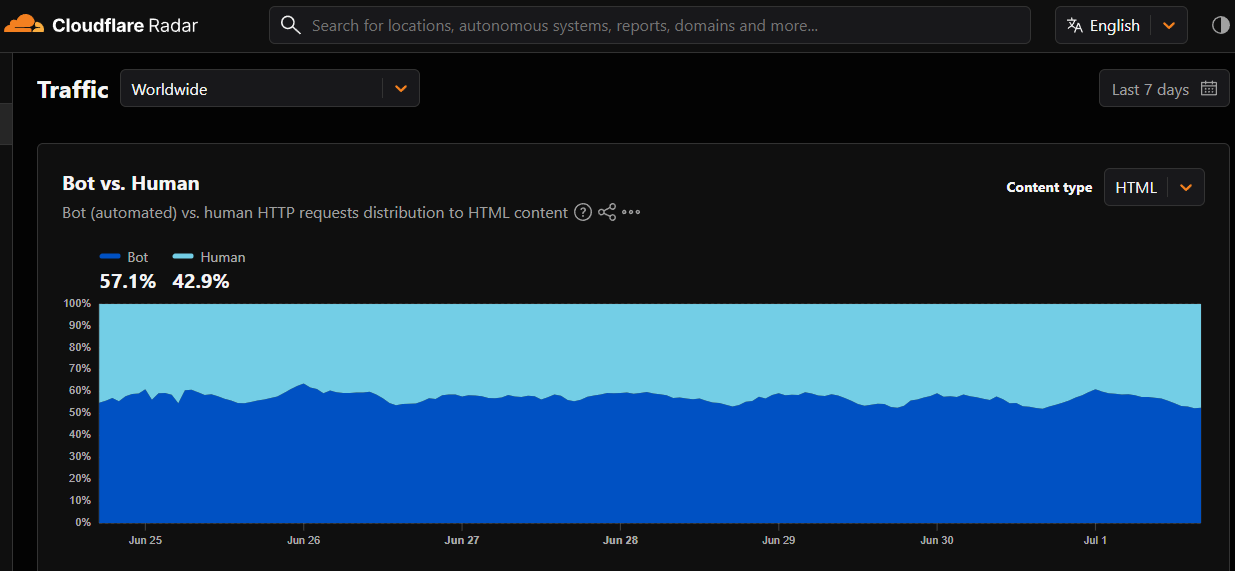
Cloudflare Radar metrics as of July 1, 2026
What a time to be alive–every day we take one step closer to proving the dead internet theory. I, for one, look forward to our future bot overlords.
This development has all kinds of implications: eCommerce, digital advertising, conversion funnels, publisher monetization, and even user experience (UX). These channels were all architected around human usability. Human attention. Human memory. But the bots fundamentally break these economics.
The marketing industry is especially impacted by this news. Not only because of our increasing reliance on the digital aspects of marketing, but also the fact that most marketing strategies are built around the assumption that site traffic, link clicks, ad views, etc. are by humans–not bots.
That’s not to imply that somehow marketers have messed up by becoming too reliant on these digital channels. Not at all. It’s more like we're the lion tamer. We spent years training the lion to do amazing tricks for the audience: our fellow executives, future customers, the company itself. Then one day the lion realizes it's stronger than we are. Now it's out of control, and it's coming for us.
For decades, companies have operated under the assumption that internet traffic comes from people. Now that this long-held assumption is incorrect by every measure, where does that leave us? What are the actual implications of it all?
PPM Advertising Should Die (Hallelujah)

Pay-per-impression (PPM) advertising was already a scam before this news came out. With this latest revelation, it should be dead in the water.
For the unfamiliar, PPM is an advertising model where you pay a flat fee for every ~1,000 views that your ad receives. You’re paying strictly for ad visibility, making it highly (re: entirely) dependent on impressions rather than click-through.
PPM ads had their value once upon a time when the internet was more human than bot, and when the ad platforms themselves measured impressions honestly. These days, neither is true.
For years now, Meta, Google, and other popular ad platforms have registered an impression using the “Zero Pixel” rule. An impression registers the exact moment an ad loads and becomes visible in a user's feed. This means if you open Instagram, and do some nonstop, rapid-fire scrolling at max speed without stopping at any point, every ad that loads will register 1 impression from you.
How many of those ads did you actually see? Or interact with? Or can even recall? According to Meta that’s irrelevant, because your ad appeared and they’ve successfully met the bare minimum of their obligation as an ad platform.
For anyone who believes this is exaggeration, I invite you to read up on Meta’s own Description of Methodology, which states “...an ad impression is counted the instant any part of the ad appears on screen (i.e., greater than zero pixel and greater than zero second).”
Does that sound like a valuable use of your marketing dollars? No, of course not.
Unsurprisingly Meta claims they can detect bot traffic and prevent it from impacting your campaign. But does anyone actually believe that? If so, what’s prevented Meta from simply removing all bot accounts across all of their platforms? Are they capable of doing this but simply refuse to? Or, more likely, they can’t detect bot traffic accurately, and therefore cannot backup any claims of preventing bots from bleeding your campaign budget.
In all fairness, there’s still a case to be made for PPM ads in niche applications. For example if your campaign goal is strictly brand recall, then sure – fire away on those PPM ads. You’ll still be advertising to bots a majority of the time, but the ad will probably (hopefully) hit a few human eyeballs over the course of the campaign.
The value of PPM ads was questionable to begin with, but now that bot traffic outnumbers humans, the debate is over. You might as well take a fistful of cash and throw it out the window, because it’ll likely have the same conversion rate as those PPM campaigns.
Your Website Analytics Are (Unintentionally) Lying To You

As someone who swears by site analytics and SEO reports, this likelihood stings the most. Unfortunately, our spikes in website traffic and referral data really can’t be trusted without some kind of aggressive bot filtering.
Prince (Cloudflare CEO) described the dilemma quite eloquently during SXSW back in March, dubbing it the “request-volume asymmetry.” To oversimplify, his core point was that a human shopping for something online visits maybe ~5 websites. An AI agent doing the same task visits 5,000 sites, because they gather information differently (much to my earlier point about bot traffic impacting user experience).
For those of us actively managing these sites, this means engaged sessions and visitor metrics get inflated, which in turn makes content performance look better than it is.
There’s also something to be said for how even our beloved A/B tests risk contamination if bot traffic doesn’t happen to be evenly distributed across each variant being tested.
Social Media Metrics Are Even Less Trustworthy Than Before

Follower counts, view counts, and engagement rates were already games. This latest development just confirms that the problem extends platform-wide.
Thankfully the days of assuming that “large social following = strong brand” are already behind us. Even the most uninformed manager is aware of how easily the “follower count” game can be, and is, manipulated these days. Same for comments on company posts. How many times have you seen automated comments like “Send me this post” or “Great post!” on any content with the audacity to include a location?
Of course, automation has (almost) always existed on the internet–mostly in the form of crawlers, scripts, background processes, etc. But what’s changed more recently is the scale, the sophistication, and the purpose of those automations. And because these tools are baked-in to most platforms, and therefore more accessible, it’s easier than ever for someone to setup a lazy auto-comment bot.
I believe “shares” and “saves” are still a semi-reliable metric for social post engagement by real humans, but who knows how much longer that will last.
Your Funnel Data Is Getting Muddied

Nothing makes a marketer happier (myself included) than seeing an airtight attribution model, accurately portraying a customer journey through the funnel. It’s the marketing equivalent of feeling those scissors glide effortlessly across your wrapping paper. Pure ecstasy.
With bot traffic now outnumbering humans, though, those multi-touch attribution models–at least the ones built around click/view data–inherit a lot of noise from AI traffic. It can quickly take a beautiful, crystal clear funnel and muddy the data with irrelevant clicks and views with no real human behind them.
In my experience this mainly impacts the top of your marketing funnel, the earliest stages of your intended customer journey. You’ll see a spike in traffic for the top-level search terms and questions your audience asks when first exploring, with a steep drop-off in traffic when it comes to the next stage of your funnel. I consider this a good thing, because the remedy is to simply shift your focus from top-of-funnel metrics to mid-funnel. If the early funnel stage is flooded with AI and bot traffic, then focus on optimizing your mid-funnel stages since that’s where most humans are taking the reigns from their AI counterpart and picking up where the AI agent left off in their research.
Another alternative is for marketers to shift our focus to outcome-based metrics–leads, purchases, verified conversions, etc–over volume metrics. It’s less than ideal since not all marketing efforts have a direct path to lead generation, but at this point we have to bake with the flour we have.
The Game Plan Moving Forward

What’s to be done about all of this? How else should we adapt?
This is one of those moments where it’s easy to become overwhelmed or discouraged, if nothing else than by the sheer volume of the problem. But the important thing is to focus on the items that are within your control.
You can’t control bot traffic. You can’t control how quickly AI evolves. You can’t control the general public’s affinity for AI and the advantages (as well as disadvantages) that it presents. But that does not mean that you’re without options.
For example, focusing on owned channels. Your email lists, SMS database, loyalty programs, and the like. Channels where you know the audience is real, because you’ve cultivated that list yourself. Are these 100% foolproof and guaranteed to be AI-free? Probably not. But you can confidently assume that the number of bots is significantly lower in those lists.
Similarly, this also means we must stop relying exclusively on raw pageviews, impressions, and other misleading metrics. That’s not to say that these metrics no longer matter–not at all. I’m saying that we can no longer consider these stats as completely reliable. I’ll be the first to admit that I tend to check site traffic as a first touchpoint any time I’m investigating an anomaly–whether a spike in conversions, a dip in clickthrough rate, or whatever else. But this is no longer reliable when ~57% of all traffic was never human to begin with.
Lastly, keep an eye out for new tools that are likely on the horizon to address this exact problem. If history’s any indication, a widespread commercial pain point rarely lasts long when there’s money to be made from an effective solution.
I believe we can expect to see new tools emerging in the form of human verification advertising products, “proof of humanity” style platforms, and similar–whether standalone products, or new features implemented directly inside an ad platform itself.
I’d be surprised if these aren’t commercially available within the next ~12 months. The advertising industry alone is simply too large for this widespread issue to go unaddressed for too long. There’s money to be made here for whoever does it right.